

Once again the flames of war have sparked into life in the Palestine/Israel region. This time Hamas took the inciative to start the atrocities. They did not act alone in this attack, militants from the PFLP also took part in the armed assaults. The pictures are unbearable: civilians murdered in the streets, and in their homes, the taken of hostages etc.
Although the Israeli government conducts a system of political Apartheid, which has even been acknowledged by Tamir Prado, the ex-director of Israel's Intelligence service. But that does not justify the conscious murder civilians. That is as condemnable as the murder of Palestinian civilans by the Israeli army! Without a doubt the response of the Israeli government will be just as terrible as it is blind. Already buildings in Gaza are being bombed and electricity has been cut throughout the whole territory.
We can only express our deepest fears and concern for the civilian inhabitants, Palestinian and Israeli both hostages to their respective governments in this conflict, and we must remember that during these past months the civilian populations had been demonstrating against their own governments and this lethal politics; over the past weeks, especially since the 30th of July thousands of people in Gaza have been protesting against the rule of Hamas under the slogan "We Want to Live!"
At the same time in Israel, tens of thousands had repeatedly took to the streets to oppose the right wing policy of the government which was no longer capable of controlling the protests and was heading toward collapse.
The attacks by Hamas therefore have occurred while on both sides of the wall of shame thousands of people had begun to organise themeselves against their rulers.
The violence unleashed by these attacks will unite the people with their corrupt rulers and strengthen the nationalist fervour, fueled by desires for mutual revenge.
In Gaza, Hamas is calling for the whole population to rally behind its flag in an united front. Already Netanyahu has formed a government of national unity. The thousands of reservist soldiers who have been striking for weeks after announced the break up of their movement!
This attack also has an international dimension. It happened after the leader of Hamas met with Ayatollah Ali Khamenei the leader of Iran and while Saudi Arabia - an enemy of Iran- has begun building official relations with Israel. Hezbollah the terrorist puppet of Iran in Lebanon has already declared that "the attack by Hamas against Israel sends a message to anyone who tries to normalise relations with Isreal or hopes that the Palestinian struggle is dead".
In the aftermath it is the inhabitants of Israel and Gaza who will pay the price for this bloody game played between states in order to cement their own power.
Once again, those who decide to have a war are not those who die in it.
Once again, the civilian will suffer, from Sderot to Gaza. All ideologies of power, especially nationalism and religious fervour are the pillars of logic that encoruages people to kill each other for the benefit of the rulers of the world.
CNT-AIT
 | |
| During the pandemic two nurses in Ramdam hospital display an essential message. "We refuse to be enemies. For a just and lasting peace!" |
HALTIGU LA BARBARECON !
Denove la milito ekflamas en la Palestina/Israela regiono.
Ĉi-foje la Hamaso prenis la iniciativon komenci la
barbarecon. Ĝi ne estas sola en tiu atako, ankaŭ sturmantoj
de la FPLP partoprenas la armitajn agojn. La bildoj estas
neelteneblaj: civiluloj murditaj sur la stratoj aŭ hejme,
ostaĝigoj.
Kvankam la israela registaro kondukas politikon
kvalifikitan apartismo, eĉ de la eks-direktoro de la israelaj
spionservoj Tamir Prado, tio tute ne pravigas plenkonsciajn
murdojn de civiluloj. Tio estas tiel kondamnindaj kiel
mortigo de palestinaj civiluloj fare de la israela armeo !
Sendube, la milita respondo de la israela registaro estos
same terura kaj blinda. Jam konstruaĵoj de Gazao estis
bombaditaj kaj elektro estas interrompita en la tuta teritorio.
Ni nur povas esprimi la plej grandajn timojn por la civilaj
loĝantoj, palestinaj kaj israelaj, ostaĝigitaj de la iliaj
respektivaj registaroj en tiu konflikto kaj tio, dum tiuj
loĝantoj manifestaciis de monatoj kontraŭ siaj propraj
registaroj kaj ties mortigaj politikoj: dum la lastaj semajnoj,
kaj precipe la pasintan 30an de julio, miloj da Palestinanoj
manifestaciis en Gazao kontraŭ la politiko de la Hamaso per
la slogano « ni volas vivi ».
Samtempe en Israelo, dekoj da miloj da israelanoj multfoje
surstratiĝis kontraŭ la politiko de la dekstra registaro, kiu ne
plu kapablis kontroli la manifestaciojn kaj direktiĝis al
kolapso.
La atako de la Hamaso do okazas, kiam – ambaŭflanke de
la muro de la honto – la loĝantoj komencis memorganiziĝi
kontraŭ siaj estroj.
La perforto senbridigita de tiu atako tute male unuigos la
loĝantaron ĉirkaŭ tiuj koruptitaj estroj, plifortigante la
naciismajn sentojn nutratajn per deziroj de reciproka venĝo.
En Gazao, la Hamaso alvokas la sakralan unuiĝon malantaŭ
sia flago. Jam Netanjahu anoncas registaron de nacia unuiĝo
; la miloj da rezervistaj soldatoj, kiuj strikis de semajnoj
anoncis interrompon de sia movado !
Tiu atako aliparte intervenas, dum la ĉefo de la Hamaso
renkontis la ajatolon Ali Khamenej en Teherano pasintan
junion, kaj ke Sauda Arabio – reĝimo malamegata de Irano
– interdiskutas kun Israelo por starigi oficialajn rilatojn. Jam
la Hizbulaho, terorisma marioneto de Irano, anoncis, ke « la
ofensivo de la Hamaso kontraŭ Israleo konsistigas mesaĝon
al tiuj, kiuj provas normaligi siajn rilatojn kun Israelo por
esprimi, ke la palestina lukto ne mortas ».
Post la israela loĝantaro, ja la loĝantaro de Gazao pagos la
prezon de tiuj sangoplenaj ludoj inter Ŝtatoj por certigi sian
potencon.
Unu plian fojon tiuj, kiuj decidas militojn ne estas tiuj, kiuj
mortas en ĝi…
Unu plian fojon, la civiluloj suferos, de Sderoto ĝis Gazao.
Ĉiuj ĉi ideologioj uzitaj de la potenco, nome naciismojn kaj
religiojn, estas la pilieroj de tiu mortiga logiko, kiu instigas
la homojn intermortigi sin por la plej granda profito de la
estroj de tiu mondo.
CNT-AIT
http://cnt-ait.info/2023/10/09/halte-a-la-barbarie/
dankon al nia amiko http://neniammilitointerni.over-
blog.com pro la traduko

Since 2019 Azat Miftakhov has been imprisoned by the authorities of the Russian Federation. Azat is a young Mathematician and doctoral student at the Lomonosov Moscow State University, and an Anarchist activist. He was sent to pre-trial detention for two years before being sentenced to a six-year prison term on trumped-up charges based on false testimony acquired through torture.
In fact, one of the two accusers whose testimony alleged that Azat threw a smoke grenade through the window of the office of United Russia, the political party of Putin, was conveniently found to have died before a cross-examination could take place.
A third "witness" is now a refuge in France and in March 2023 wrote to the online journal Mediapart, describing the torture he received by the FSB to secure a denunciation of Azat. Currently, that testimony has not been used against Azat, but it could form the basis of a future persecution.
Statements of support demanding Azat's release come from all over the world and have multiplied and include Non Governmental Organisations like Memorial and Human Rights Watch, intellectuals, Russian academics, over 2,500 Mathematicians from in 2022 and Mathematical societies in France, Italy, Brazil, the USA, and union activists in several unions including the Russian University Solidarity union.
While his release is supposed to happen any day between now and September 2023, we fear based on the information we have received that the Russian security services are plotting fresh charges against him to keep this university student in prison for years to come.
For freedom of expression in Russia
For Human Rights
Azat must be freed
The Russian Federation has invaded Ukraine and is increasing the risk of a widespread escalation. We, the defenders of peace, consider the freedom of expression of the Russian people and the freedom of expression of all people's involved in is the decisive question to find a way out for the peoples of Ukraine and Russia.
We, university students, intellectual, political activists, union members, elected representatives, association officials, journalists, citizens etc, in diversity of our opinions and activities - forewarned by the Russian student group FreeAzat, add our voices to those already expressed across the world. We solemnly demand that the government of the Russian Federation release Azat.
Links to show support (in French)
Please add your voice:
First list of signatories:
https://blogs.mediapart.fr/solidarite-freeazat/blog/020623/liberte-pour-azat-miftakhov
Second list of signatories:
A video made by supporters of Azat explaining the case in greater detail.
Here is some additional information. Originally in 2019 Azat Miftakhov was arrested on a charge of manufacturing explosives. He was detained in a police station for three days and was tortured. Since he still refused to co-operate and maintained his innocence, he was released due to lack of evidence. But before his release was processed, new charges against him relating to allegedly damaging a United Russia party office were filed based on the testimony of several people who were also tortured.
Reddebrek
The
ISK [Militant Socialist
International] and its relationship to
Vegetarianism and Esperanto
Text of a lecture for the Vegan Meeting in Castle Gresilion Paris on the 2018-05-11.
ISK
Vegetarianism in the ISK: History according to End the Slaughter!
ISK, Esperanto and SAT
Sources

[Note; While translating the first section of Gary Mickle's text
I discovered that most of the first section had already been translated
into English and was being used as the English wikipedia page entry for
the ISK. So I used that and translated the parts that were not in it.
Section 1's Political ideas through to the end is my translation.
Reddebrek]
1. ISK
The Internationale Sozialistische Kampfbund (ISK) was a socialist split from the Social Democratic Party (SPD) during the Weimar Republic period, and it was active in the resistance against National Socialism (Nazism). Internationally it used the names Militant Socialist International (in English), Internationale Militante Socialiste (in French) and in Esperanto the name Internacio de Socialista Kunbatalo.
History
Founded in 1925 the ISK was the political organisation and platform for a circle that had gathered around the philosophy of Göttingen Leonard Nelson and his collaborator Minna Specht. It was preceded by an organization the International Socialist Youth League (ISJ) that arose in the context of the youth movement of the turn of the century, founded by Nelson and Specht in 1917 with the support of Albert Einstein. Leonard Nelson, philosophically speaking heavily tied to Neo-Kantianism- wanted to become a University Professor whose political impact surpassed the limits of the University. He was a defender of an ethically motivated, anti-clerical, anti-Marxist, but also anti-democratic oriented socialism, which included strict compulsory adherence to animal protection and vegetarianism. Nelson decided to found the ISK, after the ISJ were expelled from both the Communist Party (KPD) in 1922 and the SPD in 1925.
The ISK took over the ISYL's publishing label, Öffentliches Leben, which published the ISK newsletter beginning January 1, 1926. Beginning January 1929, an edition in Esperanto was added, and in April, a small circulation quarterly in English was added as well. It was usually eight pages and editions ran an average of 5,000 to 6,000 copies. Nelson moved his main published works there as well, his philosophical and political series Öffentliches Leben and his 1904 treatises, "Abhandlungen der Fries’schen Schule, Neue Folge", re-reasoned with mathematician Gerhard Hessenberg and physiologist Karl Kaiser, and which, after Nelson's death, was continued by Nobel Prize winner Otto Meyerhof, sociologist Franz Oppenheimer and Minna Specht until 1937.
With the growing electoral success of the Nazis at the end of the Weimar Republic, the ISK founded the newspaper, Der Funke to confront the situation. Of particular note was the "Urgent Call for Unity" (Dringender Appell für die Einheit) regarding the July 1932 federal election. It appeared in the newspaper and on placards all over Berlin. Calling for unity and support of the SPD and the KPD in order to thwart further gains by the Nazis, it was signed by 33 leading German intellectuals, including scientists Albert Einstein, Franz Oppenheimer, Emil Gumbel, Arthur Kronfeld, the artist Käthe Kollwitz, writers Kurt Hiller, Erich Kästner, Heinrich Mann, Ernst Toller and Arnold Zweig and many others.[3]
The ISK continued to work in the resistance after the 1933 Nazi ban. The ISK had destroyed all written party records and until 1938, remained undetected, while the larger parties, the KPD and SPD, were being battered by massive arrests. The ISK was therefore able to continue its resistance work, helping political refugees leave the country, conducting sabotage and distributing leaflets. In 1938, however, a wave of arrests hit the ISK.[4] A main focus of the work was the attempt to build a clandestine trade union, the Unabhängige Sozialistische Gewerkschaft ("Independent Socialist Union"), which also supported the Internationale Transport Workers' Federation.[5] The ISK's best known act of resistance was the sabotage of the opening of the Reichsautobahn on May 19, 1935. The night before Hitler's trip to inaugurate the new highway, ISK activists wrote anti-Hitler slogans, such as "Hitler = War" and "Down with Hitler", on all the bridges along the route between Frankfurt am Main and Darmstadt, where he was to travel.[6] The Nazi propaganda film produced of the event had to be edited numerous times.
In exile, the ISK also published the Reinhart Briefe ("Reinhart Letters") and Sozialistische Warte, which were then smuggled into Germany. Because of their factual and unpolemical reporting, these were valued by various members of the German Resistance. The ISK was linked with the Socialist Vanguard Group in England and the Internationale Militante Socialiste in France.
After World War II, the ISK was merged into the SPD on December 10, 1945 after talks between Willi Eichler, chairman of the ISK and Kurt Schumacher, then chairman of the SPD. Most of the former ISK members then joined the SPD.[5]
One prominent member of the ISK, Ludwig Gehm, was later the national vice chairman of the Committee of Formerly Persecuted Social Democrats (Arbeitsgemeinschaft ehemals verfolgter Sozialdemokraten) and a Frankfurt am Main city council member from the SPD. Eichler, who was chairman of the ISK for many years, represented the SPD in the Bundestag from 1949 to 1953 and is considered one of the main authors of the Godesberg Program. Alfred Kubel was a member of the Lower Saxony state government for many years and was Ministerpräsident from 1970 to 1976. Hamburger ISK member Hellmut Kalbitzer was elected to the Bundestag several times, served in the Hamburg Bürgerschaft and from 1958 to 1962, was vice president of the European Parliament. Fritz Eberhard, who was in the ISK until 1939, was a member of the Parlamentarischer Rat ("Parliamentary Council") and was involved in writing the postwar constitution, including the right to conscientious objector status in the new laws of the Federal Republic of Germany.
Eichler also published a monthly magazine from 1946 until his death in 1971, Geist und Tat, which was devoted to "rights, freedom and culture" and he had a publishing house, Europäische Verlagsanstalt until the 1960s.
The ISK never set out to amass a large membership, but rather to become an active and hard-hitting organization. Membership requirements for prospective candidates included adherence to a certain ethical socialism that were more stringent than for the major parties.
Members were to abstain from nicotine, alcohol and meat, were to be absolutely punctual and orderly, and because of the anti-clerical position of the organization, withdrawal from church affiliation was mandatory
Participation in a trade union, the ISK and the labor movement was general requirement for members (eliminating passive membership)
Instead of a membership fee, there was a "Party tax," which all members with an income over 150 Reichsmarks had to pay
The ISK never had more than 300 members, largely because of the strict requirements for membership. These members were organized into 32 local groups. However, its political work involved sympathizers, between 600 and 1,000 in 1933. A survey in 1929 revealed that 85% of ISK members were under 35 years of age.
Chairmen of the ISK (formerly, the ISYL)
1922–1927, Leonard Nelson and Minna Specht
1927–1945, Willi Eichler and Minna Specht
From 1924 to 1933, the ISK (and its forerunner, the ISYL) maintained its rural school, the Walkemühle in the Adelshausen quarter of Melsungen, Hesse and from 1931 to 1933, its own newspaper, Der Funke, both of which were banned by the Nazis.
Political Ideas
The relationship between the rank and file ISK membership and its founder and chief ideologue Leonard Nelson has been described as a “personal cult”. Nelson rejected the democratic principle, in which the majority decision is to be treated as rational. In its place he used what he called a rational-leader-principle, which has some obvious problematic elements. Nelson promoted the concept of a rational dictatorship, believing that it was possible to ascertain in an objective manner what needed to be done. The ethics of science would become the foundation of a politics of science. Nelson believed that science could show what is just, i.e. in accordance with moral law, so the rational individual who has a keen enough grasp of science will know the moral and intellectually best ways to run society they must be free from limits. An all-powerful state should carry out any and all reforms deemed necessary.
Nelson opposed the Marxist teachings of the historical necessity of capitalism to the development of socialism and communism. Instead he promoted human responsibility and the necessity of a “moral compass”. He based these beliefs in his readings of Immanuel Kant.
Since its creation ISK was strictly anti-nationalist and anti-militarist. During the war Eichler publicly expressed opposition to the dogma of national sovereignty. The ISK also practiced sexual equality amongst its membership by promoting equality of rights for women.
The group promoted a mix of non-authoritarian and authoritarian structures within its orbit. On the one hand its educational service Walkemühle instructed both adults and youths on the importance of critical thinking and some of the latest concepts of the time. While on the other hand ISK described the training of civil servants as an example of authoritarianism.
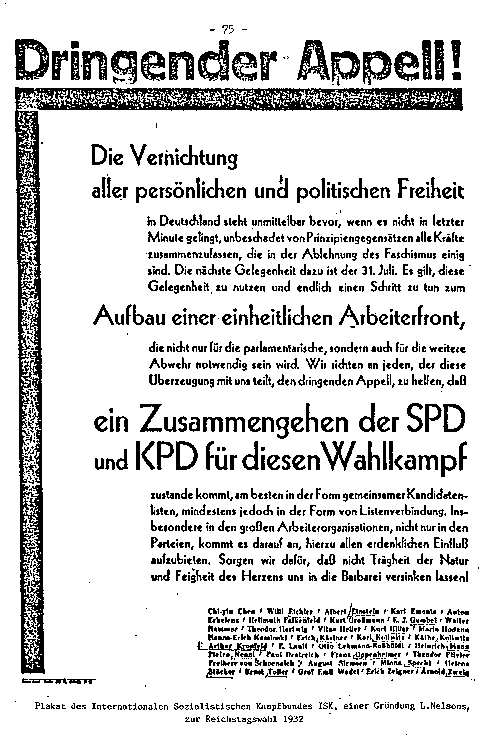 |
| Poster of the “Internationaler Sozialistischer Kampfbund” (ISK),
a foundation of
Leonard Nelsons for the parliament elections in 1932. Signed by Kronfeld, Albert Einstein and Franz Oppenheimer and well known artists like Kurt Hiller, Erich Kästner, Karl and Käthe Kollwitz, Heinrich Mann, Ernst Toller and Arnold Zweig. |
2. Vegetarianism in the ISK and the anti-Fascist Resistance
As described, a vegetarian way of life was a mandatory membership condition in ISK. Through its publications it propagated vegetarianism in Germany and abroad. It organized group visits in slaughterhouses to convince the workers to renounce their work and the other violent ways humans relate to animals. Willi Eichler ISK co-president since 1927 documents one of these visits in his 1926 essay “Even Vegetarians?” Recently that essay has been circulated again by social democrats acting in the group Sozis für Tiere (Social Democrats for animals). Willi Eichler would join the SPD in the aftermath of the Second World War and moderate his politics. He led the commission that developed the social democratic Program of Godesberg (accepted in 1959), in which the idea of socialism appeared only in a very diluted form, and which many later regarded as a road map for the right-wing in that party. I could not find out if he remained a lifelong vegetarian.
Nelson agreed with Eichler: "A worker who wishes more than a guarantee he will not become a capitalist and for whom the fight against all exploitation is a serious matter, he does not bow before the pressure of public opinion toward the habit of exploiting harmless animals, he does not participate in the daily millionfold murder."
The resistance activity of the ISK against the Nazi rule was effective, if we consider the enormous difficulties and the small membership. Cunning means were applied, and one of them made use of vegetarianism - more on that later.
At the beginning of Nazi rule, the ISK formulated 4 objectives for resistance activity: information, propaganda, anti-Nazi actions, and security for the group. One means was illegal leafleting. The Nazis held elections of worker representatives in companies, admitting only "suitable" candidates. The ISK campaigned for a vote of no confidence against all candidates - until the Nazis gave up on the elections in 1936 due to the lack of popular support for their picked candidates. (Only 50-60% voted for the official list.) Also in 1936, ISK members also collected money in workplaces for the resistance in Spain.
At the inauguration of a highway, it was discovered that the bridges were painted overnight with chemicals that can be seen only when daylight hits them, and the speaker systems had been sabotaged. Two SS members were later executed for insufficient vigilance. Invisible paint, which is visible in daylight, was also used for to daub slogans on the pavement, using suitcases with a special mechanism. A grassy hill next to the Berlin railway was chosen for an action using fertilizer poured from canisters. After a few weeks the hill was marked with the slogan "Nieder mit Hitler" [Death to Hitler].
The ISK also discussed a plan to kill Hitler via a suicide attack, but the plan was opposed by some members and did not go beyond discussions.
The anti-Nazi activity included a set of vegetarian restaurants, which ISK members operated in several cities and used for clandestine purposes. Some had opened before 1933, the remainder opened after the rise to power from the Nazis. Large restaurants were founded in Berlin, Hamburg, Frankfurt am Main and Bochum. According to one report, the Hamburg restaurant prepared 120 lunches a day.
They were often led by women, but both men and women worked in them. The working day was long and the pay low. The restaurants served several purposes: to provide work to the unemployed, to generate a profit that was used for resistance activity, enable contact between resistance agents in a relatively unsuspicious place, serve as bases for production and distribution of illegal printing material etc. However, they also served for promote vegetarianism.
A wave of arrests in 1937 forced many restaurant workers to flee abroad or to live in hiding. Two fugitives founded vegetarian restaurants in Paris and London. The restaurant in Paris became a contact point for exiled Germans and was also a source of funds. The same for the restaurant in London. There they were supported by a group linked to Nelson inside the Labour Party, the Socialist Vanguard Group, the British affiliate to the Militant Socialist International (ISK).
Here is a somewhat extensive quote from a document from the City Archives of Göttingen, which captures the atmosphere of the era and also paints a picture of the spread of vegetarianism in Germany at the time and the political implications of it, e.g. the spread of the legend about Hitler being “Vegetarian”:
Next to the premises of the ISK in the city, the vegetarian restaurant can be seen, operated by the mother of Fritz and Helmut Schmalz on Weenderstraße 71/72. August Schmalz was member in the ISK since 1927; she had already led vegetarian cooking courses in the Walkemühle. Vegetarian restaurants were a financial pillar of the organization, although more profitable and useful for that purpose were the restaurants in the bigger cities like Berlin, Hamburg (Anna Kothe worked there since 1934, who for a long time worked in the headquarters in Göttingen as a housekeeper), Cologne or Frankfurt. Auguste Schmalz's vegetarian luncheonette has been around since at least 1931 and was a regular meeting place. Hannah Vogt recalled: “I remember a place in Weender Straße – which was led by the mother of trade unionist Fritz Schmalz – where everyone had a vegetarian lunch. Many of them regularly met there.” Since spring of 1933 the premises were observed, however the police failed to prove that the guests of the Schmalz lunchroom participated in anti government discussions.
The income opportunities that opened up with such a restaurant also attracted the greedy gaze of the "Volksgenossen" [Nazi term, roughly means People’s comrades, used as a term for correct i.e. Nazi behaviour]. In a letter to the rector of the university at the end of October 1933, someone proposed a remedy against an urgent lack of food for the students. He said that among the 4,000 students there are at least 150 vegetarians, "who now wish to live according to the way of life of our people's chancellor", but can't, because "the only vegetarian lunch place here (...) is run by the ex-communist Schmalz". According to the writer, he even makes an advertisement by posting it on the blackboard of the auditorium, despite the fact that it is possible to prove, "that the students are being influenced by propaganda there, acting at that in a very refined manner”. The author of the letter thought his “most noble task to provide the students of the University of Göttingen with the cheapest high-quality food, in accordance with the new theory of nutrition". Of course he hoped for the support from the rector for his "valuable idea, also represented by Hitler, Rudolf Hess, Göbbels (!) and even many professors in Göttingen". Schmalz's lunchroom survived despite these attacks and denouncements at least until the beginning of the war.
3. ISK, Esperanto and SAT
The ISK attempted to spread beyond the borders of Germany in their early days and adopted Esperanto as one of the means to achieve this.
Registered in bibliographies is the edition of the quarterly Esperanto-language Organo de Internacio de Socialista Kunbatalo since 1929 (before the appearance of a similar publication in English). After the Autumn of 1933 it appeared in Paris under the name The Critical Observer: magazine of politics and culture. It continued to be published until the end of 1939 if not longer. Hermann Platiel was credited as its editor after the move to Paris, but its possible that he occupied that position earlier.
The ISK published a daily newspaper Der Funke [The Spark] for 14 months, between 1932-01-01 and 1933-02-17. Then it was banned. The release necessitated great sacrifices, inevitable for such a small organization. Notable in it is the striving for a working class united front against the looming fascism and the very critical reporting on nationalism in general. The complete journal collection is now archived online. There you can find three kindly written articles about SAT and its congress from 1932 in Stuttgart. Although one would expect that their author would be Hermann Platiel, the authors used initials ("M. H.", "Rpt.", "O. W.") do not match that assumption.
Some excerpts from the articles:
Party political neutrality among the Worker Esperantists (from Der Funke 1932-06-05) In the Esperanto Labour movement, whose most important, global organization is SAT (World Anti-national Association), the party political disputes, especially between the CP and the SP, was not missing. In Germany there are already in many cities separate communist and social democratic Esperanto groups. All the more gratifying that the president of SAT, Lanti, who also publishes the Esperanto newspaper Sennaciulo, stands entirely on the ground of the party political neutrality of SAT. In an open letter to many SAT members he assumes a position against the communist attempts to link SAT to a definite political program, by which the CP wants to secure for itself a better foundation for its domination. The CP wants first, that SAT compels all members to recognize Marxism as “the correct basis on which the firm unity of the proletarian Esperantists can be founded".
[…]
In addition, Lanti quite rightly throws back the opinion that non-Marxist viewpoints such as those of Nelson, Kropotkin or Gesell should remain undiscussed in the newspaper, because "the vast majority of organized workers recognize Marxism as the theoretical basis for their class struggle”. That is totally incorrect - let's think about England, Spain or India!
[…]
It is desirable that Lanti's positions continue to be guiding SAT and its newspaper, so that the very desirable propaganda for Esperanto as an international means of understanding, especially as a tool for a fighting working class should not be hindered by a dogmatic and party-politically narrow framework.
We greet the Esperantists in Stuttgart [title originally in Esperanto] (from Der Funke 1932-08-06) In the second week of August, the 12th congress of ... SAT meets in Stuttgart. […]
SAT for two reasons is particularly called to work on the creation of the socialist united front: Its members are linked by the bond of a common language. […] SAT also fulfills an important prerequisite for the collaboration in the creation of united front of the various workers parties. The management of SAT has been resisting firmly and successfully for years against the disrespect of party political neutrality within the Association. [...]
The working Esperantists in Stuttgart (from Der Funke 1932-09-01) The 12th congress of the world association of working Esperantists (SAT) 250 comrades from 12 countries participated despite the bad economic situation.
[…]
The most important result of the congress was the re-securing of the party political neutrality of SAT.
[…]
Also the efforts to change the current structure of SAT – a union of all the proletarian Esperantists without regard to their nationality or race - by associating national associations, were unanimously rejected.
With the exception of the proposers, all the comrades emphasized the necessity right now, of a front between the workers and the growing wave of nationalism, not only emphasizing the international connectedness of the proletariat, but also to practically realize it, for which purpose the present stateless organizational form offers the best basis.
[...]
Its known that Hermann Platiel was both an ISK and SAT member. Born in 1896 (or possibly 1886) and died in 1980, Platiel was hired as an administrator for the SAT office in Leipzig from the 8th of May 1929 until 1932. In Leipzig he also led the local ISK branch. After Lanti stood down from the post it was Platiel who became the President and Director of SAT from 1933-35. SAT published his text History of the schism in the Workers Esperanto-Movement: Documentation which shows the causes and responsibilities and prepares the foundation for united action. He then became the secretary of the French Esperanto section of ISK 1938-39. I do not know if he has been active in SAT since the 40s or maintained any relationship with Esperanto at all. Petro Levi who joined SAT shortly after the war does not remember seeing him when I asked, and I was not able to find anything online, though of course there are still other sources to check,
In 1943 he illegally fled to Switzerland, and worked for the "Schweizer Hilfswerk" (Swiss Relief Fund) and wrote reports for the London foreign leadership of ISK. Before the escape to Switzerland he was located in the southern French city of Montauban, to which he fled from the internment camp in Gurs. There he married with well-known ISK member Nora Platiel (née Block). In 1949 they settled in the German city of Kassel, where Nora began a career as a court jurist and then a representative of the Hesse parliament (for the SPD). Hermann worked as a director of a theatre in Kassel, according to reports with great commitment.
This summary of facts about ISK's relations with Esperanto and especially with SAT is very incomplete. Further research would be worthwhile. Research in the archive of SAT in Paris should provide insights about that, also about Hermann Platiel personally, and would answer the question whether he and possibly others ISK members played a role in the then Vegetarian Section of SAT, which we can guess, but do not know now.
4. Sources
• Das Schlachten beenden!, Verlag Graswurzelrevolution, Nettersheim 2010 [GWR estas
monata ĵurnalo kaj eldonejo dediĉitaj al senperforta anarkiismo, kun ekologia emfazo kaj
simpatianta kun veganismo; pli ĉe www.graswurzel.net]
• Heiner Lindner: Um etwas zu erreichen, muss man sich etwas vornehmen, von dem man
glaubt, dass es unmöglich sei – Der Internationale Sozialistische Kampf-Bund (ISK) und
seine Publikationen, Friedrich-Ebert-Stiftung 2006, http://library.fes.de/pdf-
files/historiker/03535.pdf
• Vikipedio germanlingva: ISK, Nora Platiel kaj esperantlingva pri Hermann Platiel
• urba arkivejo de Göttingen: http://www.stadtarchiv.goettingen.de/widerstand/texte/isk-
goettingen_1933-1935.html
Gary Mickle
Translated into English by Reddebrek

La intermilita periodo, inter 1920 kaj 1940, estis ja riĉa je eventoj kaj ŝanĝoj por la laborista movado per la fondo de SAT, Sennacieca Asocio Tutmonda, la eldono de multnombraj libroj, inkluzive de la Plena Vortaro de Esperanto, kaj revuoj kiel Sennacieca Revuo.
(Ne forgesu, ke ĉiuj EsKu-aj filmetoj havas subtitolojn. Ne hezitu uzi ilin)
Saluton al vi ĉiuj, spektantoj de EsKu, nia nun tre bone konata kanalo pri Esperanto-Kulturo.
Se unuafoje vi malkovras ĉi tiun filmserion, sciu ke vi povas aboni la kanalon, dank’ al la butono «abono».
Tion farinte, vi ne maltrafos niajn venontajn filmetojn.
La Angla Traduko
Thiery: Hello everyone, especially the viewers of EsKu, our now very popular channel about Esperanto culture. If you've discovered this video series for the first time then you can subscribe to our channel using the "subscribe" button below. Having done that, then you will not miss any of our future videos.
What is the subject of today's talk Pascal? Your previous two talks, videos 35 and 37 sketched out the development of the Neutral* part of the movement between the First and Second World Wars. I believe you will now go on to explain the development of the Workers Esperanto movement in the same period as you hinted you would at the end of video 37.
Pascal: Greetings dear viewers of EsKu. You are right about today's subject Thierry. The interwar period between 1920 and 1940 was a time rich with experiences and changes for both flanks of the Esperanto movement. Allow me to summarize the main parts again, as I'm not capabale of giving the most specific details of the complex history of our langauge. Regarding this period the Workers Movement, and remember that in video 33 I mostly talked about the founding of the SAT, Sennacieca Asocia Tutmonda (World Anti-National Association), in the summer of 1921, and I talked about its most important founder Eugene Adam more well known as Lanti. It goes without saying that the SAT quickly prioritised adopting Esperanto practically over propaganda work. For example, it created a correspondence service to establish connections with workers organisations across the world, a press service to spread awareness of social affairs and labour unions, and founded a publishing co-operative which published several important works, including those of Tolstoy and Kropotkin. It also organised its own congresses and many study sessions.
Thierry: So, that was certainly important work by SAT, it would seem that its efforts created a chance for Esperanto to establish itself in the workers circles, right?
Pascal: Well, effectively thanks to SAT both the significance and usefulness of Esperanto began to be acknowledged more and more, even by those outside of the Esperanto movement. Our language was being used by Associations that were not officially linked to the Esperanto movement, as an example the International Workers Olympiad, the War Resisters International, the International of Socialist Struggle**, International Workers Association, International Anti-militarism Office etc. The list of associations of that sort that understood the use of Esperanto is quite long.
A resolution in favour of Esperanto was proposed in 1925 at the British Trade Union Congress. At the same time the International Federation of Transport Workers regularly promoted our language in a dedicated column in its own federal publication. And imagine this! According to a decision by the Spanish Metalist Federation congress in 1925, only Esperanto speakers were allowed to become candidates for its Central Committee.
Thierry: You just mentioned the British congress and the Spanish Federation, that gives me an urge to ask this, did the activity of SAT have an impact on an international scale?
Pascal: I will answer yes by citing this fact; after 1920 thousands of workers started learning Esperanto, this enabled them to correspond with their fellow workers in foreign countries, and to read bulletins and magazines published by several Workers Esperanto Associations (known as WEAs). We know that some of these WEAs existed since the beginning of the 20th century, even before the first Universal Congress of 1905 at Bulogne-Sur-Mer, but there number grew after the First World War. For example a Swedish Esperanto Association was created in 1921, an Austrian Esperanto League and the Polish Workers Esperanto Society "Labour" in 1922. Some these groups although they were independent of SAT collaborated with it. Meanwhile, the SAT continued to grow; its annual Yearbook which contained the contact information of its members listed 2,715 members in 1925 and 6,524 in 1929, and a lot of them were located in Russia.
Additionally, you should know that until 1925 it was forbidden for SAT members to join a "Neutral" Esperanto association. This ban was later applied less severely.
Thierry: Regarding the membership numbers of SAT in 1929 you alluded to Russia, I shall profit from this occasion to begin learning more about that nation. Because I have for a long time wanted to ask you about the unique situation of the workers movement in the Soviet Union. During the period we're discussing both the February and October revolutions of 1917 occurred there afterall.
Pascal: That's completley correct Thierry. After the October revolution the Russian Soviet Federative Socialist Republic was founded, which became the Soviet Union in 1922. In June 1921 during the All-Russian Congress of Esperanto speakers the Soviet Esperantist Union (SEU) was formed. In 1927 it changed its name to the Soviet Republican Esperantist Union. The SEU became, in addition to the SAT another important centre for the Esperanto Workers movement. Ernest Drezen presided over the SEU from its founding until his death in 1937***.
We should remember these two leaders of the Esperanto Workers Movement, Lanti with the SAT and Drezen of the SEU. Why? Because both are important but were not always aligned. While the SAT aimed to unite every left wing association, the SEU maintained allegiance to pure orthodox Marxism. During the third Congress of the SAT in Kassel (in Germany) Drezen proposed that SAT join the Third International, also called the Comintern, though that name does not appear in our dictionaries. The proposal was defeated and both organisations wisely decided to stop criticising each other.
However in 1924-25 there was a crisis within SAT because Anarchist members were alarmed at the influence of the Communist International within SAT and were frustrated at not being able to write in SAT's press criticisms of Communism and the Soviet Union. So they created their own organisation in 1924, TLES Tutmonda Ligon de Esperantistaj Ŝenstatanoj the World League of anti-State Esperantists. They also published from 1925 until 1931 an irregular newspaper La Libera Laboristo, the Free Worker. But TLES never had a major influence, and eventually most Anarchists rejoined the SAT.
Thierry: Did the crisis with the Anarchists and the rapproachment with the SEU affect the influence of SAT at that time?
Pascal: I would say that those events were an opportunity for SAT. This is proved by its 6th Congress in 1926 which was held in Leningrad. It was the first large Esperanto gathering in the Soviet Union, and even more successful as it brought together 400 participants from 14 countries. The number of SAT members grew immensely after the Leningrad Congress, I have already spoken about the 6,524 members in 1929. In that year during the SAT Congress in Leipzeig Germany 650 Esperantists participated from 22 nations. The significance of SAT was acknowledged by the Esperanto movement and even outside of it.
For the movement itself, having an organisation that holds sucessful congresses every year, and publishes a large qauntity of diverse and important works was an essential asset.
Thierry: Regarding the publishing work of SAT, I would like to know more. Could you explain its scope and importance?
Pascal: In 1922 a publishing co-operative was opened which would become absorbed into a department of SAT and run by the SAT board. Its aim was to promote literary works and improve the publication of Esperanto literature, whether translations or original works. At the beginning of the video I mentioned the works of Tolstoy Khodynka in 1929, Christianity and Patriotism in 1931, from Kropotkin Ethics in 1926, I will also mention Lenin's State and Revolution in 1926 and Goethe's Faust in 1923. Regarding original works I must mention Eugen Lanti's "Cast Down Neutralism!" in 1922, the Workers Esperantism in 1928 and the Words of Comrade E.Lanti 1931 and Letters of Eugene Lanti in 1940. I also should not overlook Norbert Bartelmes, Eugene Michalski, Paul Neergard etc.
But without a doubt the most important publication of the SAT press in this time was the Complete Dictionary of Esperanto, first published in 1930. Written mostly by Emile Grosjean-Maupin with the assistance of Albert Esselin, Saloman Grenkamp-Kornfeld and Gaston Waringhien. It immediately became and remained an important reference dictionary until 1970 when the PIV the Illustrated Dictionary appeared as its follower and replacement. About Complete Dictionary of Esperanto, a Mr. Kopar wrote in 1931, in the magazine Literatura Mondo. (Incidentally, Kopar was the pseudonym of the well-known poet and outstanding translator Kálmán Kalocsay.) Here is the quote: "Carefully made, comprehensive and detailed, a truly valuable work".
Thierry: Did SAT publish only works and this important dictionary? That's what I'm asking, because since the birth of our language, many magazines have been published quickly. Did SAT also provide periodicals to its members and to the entire Esperanto community?
Pascal: You're question is very interesting Thierry. It gives me an excuse to talk about the two main SAT periodicals published during the interwar years. The first was the monthly Sennacieca Magazine, an historical, sceintific, teaching, literary magazine which has been published since 1921 and was edited by Eugene Lanti. Between 1928 and 1933 it changed its title to the New Era, but afterwards returned to its original title. The second was Sennaciulo the official organ of SAT which was more political and socially active and it was published weekly from 1924 until 1931, when it was published fortnightly until 1933 when it became a monthly paper. It also had a montly supplement called "The Pupil".
Thierry: Thank you for your clarifications and explanations about the SAT publications Pascal. Has the theme of the Esperanto Workers movement between the World Wars been exhausted? Or will you dedicate a second video to this topic as you did with the contemporeanous Neutralist movement?
Pascal: You've predicted the future very well Thierry. There is indeed a lot more to say about the Esperanto Workers movement before the Second World War. I will dedicate video 41 to the same topic. So until then.
Thierry: Thank you Pascal, in that case we will wait for the sequel. And if you dear viewers have subscribed to our channel then you will be alerted to the publication of our next video. But if not, why hesitate over a free subscription? Don't wait to add your name to our followers. Thank you for your attention. Goodbye!
Pascal: Goodbye everyone!

*The Neutral movement is the name for what is the more mainstream and "official" part of the Esperanto movement. Despite the name it often takes positions that would be considered extremely radical (anti-militarism, cultural tolerance and language and minority rights, open borders, etc) compared to normal society. Its Neutral in the sense that its believes Esperanto should be open to everyone. The second competing current in Esperanto is the Laborista or Workers Esperanto movement.
** This is a reference to the German ISK, the International Sozialisticher Kampfbund which was an split from the German Social Democratic Party, the ISK produced some material in Esperanto as well as in English and over languages.
*** He was a victim of the purges of the Communist party carried out by Stalin. He was "rehabilitated" in 1957 and even bizarrely given back his membership of the Communist party in 1989 despite being dead for many decades.

DEKLARACIO
de la Centra Estraro de Bulĝara Esperantista Asocio
Kun granda kolero kaj indigno la bulgaraj esperantistoj eksciis pri la invado de la ĉina armeo en la teritorion de Socialisma. Respubliko Vjetnamio. Tiu insida atako laŭ fasista maniero skuis ĉiujn honestajn homojn en la mondo kaj ĝojigis nur la reakciulojn. Ek- zistas neniu fakto pri ia ajn provoko de la vjetnama popolo kontraŭ ĉina teritorio. Sed esta aliaj faktoj. Ili parolas pri senĉesa premo de Ĉinio kontraŭ Socialisma Respubliko Vjetnas mio. Tiu premo komenciĝis tuj post la sengiora fiasko de la usona agreso en Vjetnamio- Gi estas farata pro la ambicio de la ĉinaj partia kaj ŝtata gvidantaroj trudi la hegemo. nion de Ĉinio super Sudorienta Azio kaj pro la fideleco de Socialisma Respubliko Vjetnamio
al la socialismaj idealoj, al la socialisma komunaĵo kaj Sovetunio — la potenca pilastro de Sa paco kaj socialismo en la tuta mondo. Kulmino de tiu premo estas la armita agreso de Ĉinio. Per tiu abomena milito, kiun Ĉinio iniciatis, per la barbara mortigado de vjetnama virinoj, infanoj kaj maljunuloj kaj per detruado de la vjetnamaj urboj kaj vilaĝoj la ĉina gvidantaro montris al la tuta mondo, ke ĝi havas nenion komunan kun la paco, Ia humanisma kaj la internaciismo. Ĝi pli intime aliĝis al la monda imperiismo, al la plej nigraj fortoj de la internacia reakciularo. La barbara atenco kontraŭ la libero, suvereneco kaj sendependoj de Socialisma Respubliko Vjetnamio estas indigna rompo de ĉiuj kaj ĉiaj internaciaj juraj- kaj moralaj normoĵ, ĝi subfosas la pacon kaj sekurecon en la mondo, portas malfeliĉon an- kaŭ al la ĉina popolo mem.
En la nomo de ĉiuj bulgaraj esperantistoj — sinceraj batalantoj por amikeco kaj kompreniĝo inter la popoloj, por paco kaj sekureco en la mondo — la Centra Estraro de Bulgara Esperantista Asocio kune kun la tuta bulgara popolo kolere ekkrias:“ For la manojn disde Vjetnamio! Senprokrastan eltiron de la ĉina armeo el la lando de la heroa kaj liberama vjetnama popolo! Vivu la fronto de la paco kaj socialismo en la tuta mondo !“.
CE de BEA Telegramoj proteste kontraŭ la ĉina agreso venis en la redakcion de la jarkunveno de Bulgara E-Kooperativo, de la Konferenco de Nordbulgara E-Junularo en Varno (11. III. 79), ĉe multaj E-societoj.
Declaration
By the Central Board of the Bulgarian Esperantist Association.
Bulgarian Esperantists have just learnt of the invasion by the Chinese army into the territory of the Socialist Republic of Vietnam with great anger and indignation. This insidious attack by fascist means shook all honest people throughout the world and has only brought joy to reactionaries. There is no evidence of any provocation by the Vietnamese people against Chinese territory. But there are other facts. They speak of China's relentless pressure on the Socialist Republic of Vietnam. This pressure began immediately after the total failue of US aggression in Vietnam. This pressure is exerted because of the ambitions of the Chinese party and state leadership to impose hegemony. China wishes to be supreme in South East Asia, and because of the Socialist Republic of Vietnam's allegiance to its socialist ideals, the socialist community, and the Soviet Union, the powerful pillar of socialism and peace in the whole world. The armed aggression by China is the culmination of this pressure. By this abominable war, which China has instigated, by the barbarous murder of Vietnamese women, children and the elderly, and through its destruction of Vietnamese cities and villages the Chinese leadership has shown the whole world, that it has nothing in common with peace, humanity, and internationalism. It more closely belongs to the world of Imperialism and the blackest forces of reaction. These barbarous attacks against the liberty, sovereignty and independence of the Socialist Republic of Vietnam, is an indignant injury to every kind of legal and moral international norm, it endangers the peace and security of the world, and it also brings misery to the Chinese people itself.
In the name of all Bulgarian Esperantists - sincere fighters for friendship and understanding between the peoples, and for peace and security in the world - the Central Board of the Bulgarian Esperantist Association together with the whole Bulgarian people angrily declare "Get your hands of Vietnam! Immediate withdrawal of the Chinese army from the land of the heroic and free Vietnamese people! Long live the front of peace and socialism in the whole world!"
CB of BEA
Telegrams
protesting Chinese aggression came in the editorial board of the annual
meeting of the Bulgarian Esperanto Co-operative, of the North Bulgarian
Esperanto Youth Conference in Varna (II. III. 79) and from many other
Esperanto organisations.
Source:
Bulgara Esperantisto. Jaro 48, n. 3 (1979)


